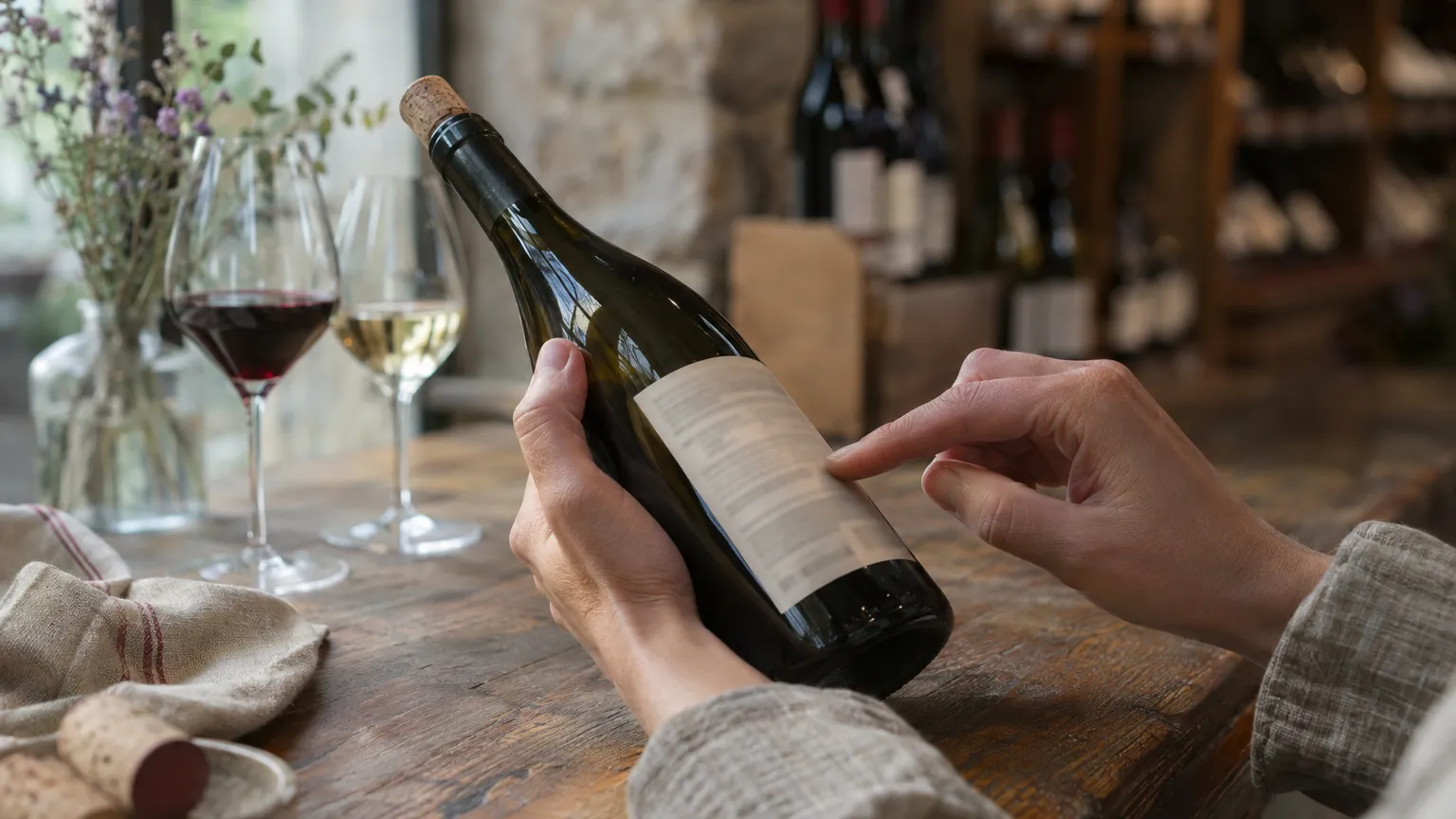
To read a wine label, first look for the appellation or indication of origin, rather than the name in large print. Then find the vintage and grape variety, if they appear on the bottle. Turn it over to check the alcohol content, volume and identity of the bottler. These details describe the wine; none of them gives it a quality rating.
The essentials
- “Chablis” is an appellation; “Chardonnay” is a grape variety. A cuvée name, on the other hand, does not guarantee the origin of the grapes.
- AOP, IGP and Vin de France indicate where the grapes come from, from the most specific to the broadest origin.
- The vintage and grape variety are generally optional. Alcohol content and volume are mandatory.
- “Grand cru” and “Premier cru” are regulated; “Vieilles vignes” and “Réserve” are not in France.

- Estate name
- Cuvée name (optional)
- Appellation
- “Appellation contrôlée” designation (AOC or AOP)
- Vintage (optional)
- Bottler
- Volume
- Alcohol content
- Sulphites
- Pregnancy warning symbol
- Lot number
- Barcode
- Ingredients and nutritional information (code)
How can you tell the appellation from the cuvée name?#
On a French bottle, look for the wording “appellation d’origine contrôlée” (AOC) or “appellation d’origine protégée” (AOP). The geographical name alongside it identifies the appellation: the grapes come from a defined area and the wine meets a set of production rules. For an AOP, all the grapes come from that area. For an indication géographique protégée (IGP), the requirement is at least 85%.
The estate name identifies the producer. The cuvée name, which is optional, distinguishes one wine from the others it produces. An estate can therefore offer two cuvées under the same appellation. If you are choosing between these two bottles on a shelf, the cuvée name will help you find the one you picked.
AOC, AOP, IGP, Vin de France: what does each designation guarantee?#
These designations indicate where the grapes come from and which rules the wine has followed. They do not rank wines by quality: a Vin de France can be excellent, an AOP disappointing. They do, however, tell you what to expect from the bottle.
| Designation | Origin of the grapes | What it guarantees |
|---|---|---|
| AOC or AOP | 100% from the appellation’s defined area | A set of production rules covering permitted grape varieties, yields, cultivation and winemaking. AOC is the French name, AOP the European name: both refer to the same thing. |
| IGP | At least 85% from the named area (for example Pays d’Oc) | Production rules more flexible than those of an AOP, with a wider choice of grape varieties. |
| Vin de France | Anywhere in France, from one or more regions | French origin, without a specific region. The grape variety and vintage may be stated. |
| Vin de l’Union européenne | Several EU countries | Only the wine’s European origin. |
To explore the appellations themselves, region by region, browse the French wine appellations.
WITH VINIOU One photo, and it’s in your wine cellar Scan the label, Viniou recognises the bottle instantly.What do “Chablis” and “Vin de France” reveal about the grapes?#
Compare two labels. On the first, you read “Chablis” and “2022”, but no grape variety. On the second, “Vin de France” and “Chardonnay”, but no year.

| What you are looking for | Chablis 2022 | Vin de France, Chardonnay |
|---|---|---|
| Origin | The grapes come from the defined Chablis area, in the Yonne. | The grapes were harvested in France and the wine was made there. “Vin de France” does not specify the region where the grapes were harvested. |
| Grape variety | The Chablis production rules require Chardonnay. The word does not need to appear on the bottle for you to know the grape variety. | “Chardonnay” is the only grape variety stated: at least 85% of the wine is made from it, but not necessarily 100%. |
| Harvest | 2022 is the vintage, not the bottling year. | The label does not tell you when the grapes were harvested. |
When a label names several grape varieties, together they account for the entire wine and are listed from the largest proportion to the smallest.
What does the year on the label guarantee?#
The vintage is the year the grapes were harvested. As a general rule, at least 85% of the grapes must have been harvested in the year stated. A Chablis 2022 bottled in 2023 is therefore still a Chablis 2022.
If there is no vintage on the label, do not assume the wine is a blend of several years. The producer may also have used grapes from a single harvest without stating the year. The vintage also helps you decide when to open the bottle: our guide to spotting wines ready to drink starts with that year.
What do “Grand cru”, “Premier cru”, “Vieilles vignes” and “Réserve” mean?#
These terms look similar on a label, but they do not carry the same weight. Some are defined by appellation rules, while others are freely chosen by the producer.
| Term | Regulated? | What it means |
|---|---|---|
| Grand cru | Yes | In Bourgogne, the highest classification for vineyard plots (climats), as in Chablis Grand Cru. In Alsace, one of 51 classified sites. In Champagne, the highest-ranked villages. |
| Premier cru | Yes | In Bourgogne, vineyard plots ranked just below grands crus. The climat name often follows the village name. |
| Grand cru classé | Yes | In Bordeaux, a château included in a classification, such as the 1855 classification. Not to be confused with the “Saint-Émilion grand cru” appellation, which is not a classification. |
| Vieilles vignes | No | No minimum vine age is specified in France: each producer uses the term according to their own criteria. |
| Réserve, Grande réserve, Cuvée prestige | No | A marketing term used by the producer for their French wines. In Spain (Reserva) and Italy (Riserva), however, the term requires a period of ageing. |
Which mandatory details should you check on the back of the bottle?#
For a still wine sold in France, origin, alcohol content, volume and identification of the bottler are among the mandatory details. They can appear on the back label or the front. “12.5% vol” indicates the proportion of alcohol by volume; “75 cl”, the amount of wine in the bottle.
The presence of sulphites must be declared above 10 mg/l, expressed as total sulphur dioxide. “Contains sulphites” indicates that this threshold has been exceeded, not the exact quantity. In France, a symbol or health warning also alerts consumers to the risk of drinking alcohol during pregnancy.
For wines produced from 8 December 2023 onwards, an ingredients list and nutrition declaration are mandatory. The list and detailed nutritional information may be accessed via a code on the label. The energy value and allergens that must be declared must remain legible on the bottle.
The back label also carries optional information: serving advice, food pairings and a description of the wine. These come from the producer and are not checked in the same way as mandatory details. Finally, the barcode identifies the product at the checkout. Its first digits indicate the country where the company registered its code, not where the wine was produced: a code beginning with 3 does not prove that a wine is French.
What does “mis en bouteille au château” or “à la propriété” mean?#
The wording “mis en bouteille par” identifies the person or business that bottled the wine or had it bottled on their behalf. This is not necessarily the person or business that grew the grapes. On the Vin de France in our example, the bottler’s town therefore does not tell you the region where the Chardonnay was harvested.
“Mis en bouteille au château”, “au domaine” or “à la propriété” tells you more: the wine was bottled at the estate where the grapes were harvested and made into wine. The term “à la propriété” is also permitted for a cooperative winery bottling wines from its members. A négociant’s name followed by a town, by contrast, indicates a wine bought and then bottled by a wine merchant, which says nothing against its quality.
What should you note from the label to find the same wine again?#
“Chablis 2022” is not enough to find a bottle again: several producers may offer that vintage. Also note the producer’s name and the cuvée name, if it appears on the label.
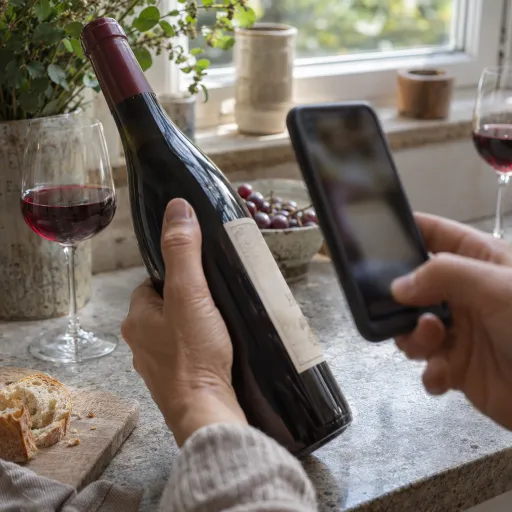
With Viniou’s Label Scan, photograph the bottle’s label: the wine is recognised and added to your cellar, with its appellation, grape variety and vintage.
Sources: Commission Delegated Regulation (EU) 2019/33 on wine labelling, Regulation (EU) 2021/2117 (ingredients and nutrition declaration), Chablis appellation production rules (INAO), DGCCRF guidance on wine labelling.
Discover the Viniou app to manage your wine cellar.