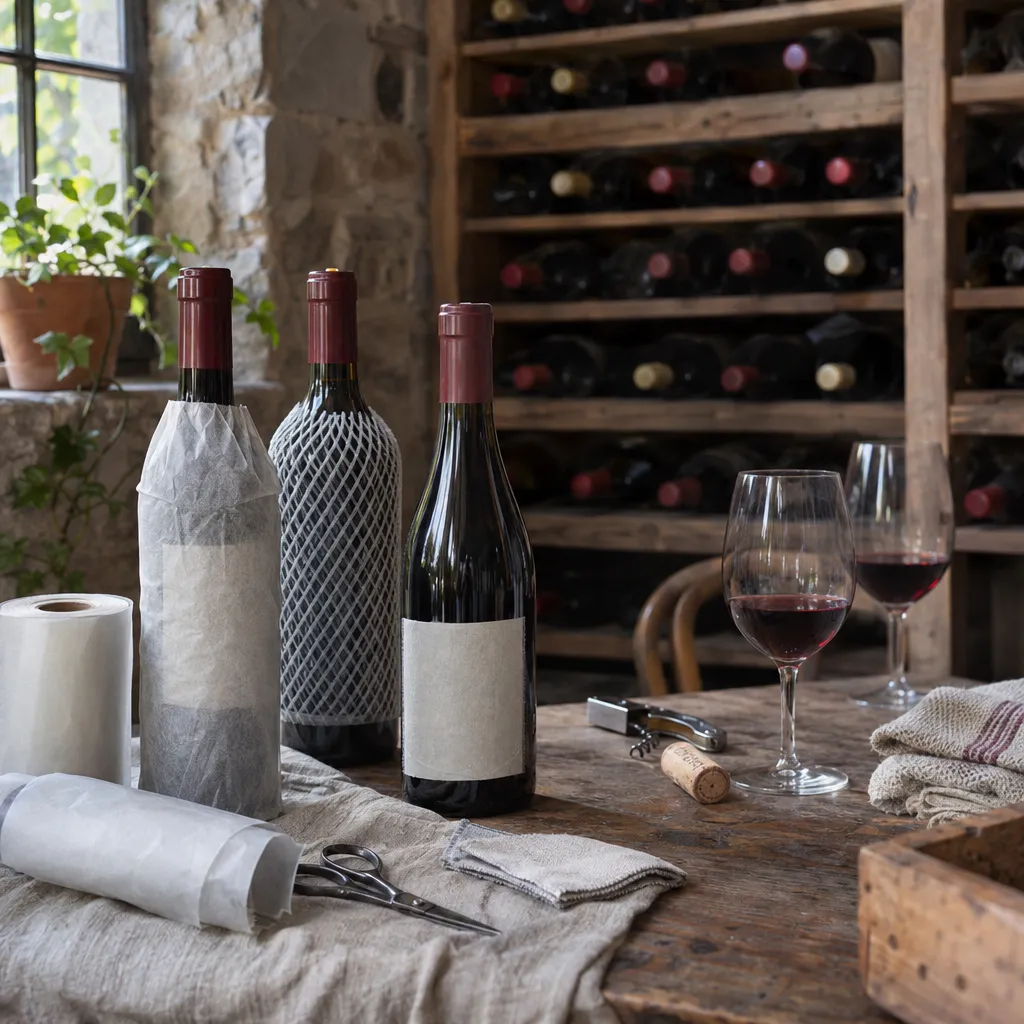
To protect your bottle labels, keep cellar humidity between 60 and 75%, prevent bottles from rubbing against each other and handle them only when strictly necessary. Above 80% humidity, the adhesive fails and mould appears; in tightly packed racks, labels wear every time a bottle is removed. For valuable bottles, tissue paper, cling film or the original wooden case can make all the difference.
The essentials
- Humidity: 60 to 75%, enough for the corks but not too much for the labels.
- One space per bottle, label facing upwards, to prevent scuffing.
- Tissue paper or cling film for fine wines kept long term.
- A damaged label reduces resale value: it matters for fine wines.
What damages labels in the cellar?
Excessive humidity. Above 80%, the adhesive softens, the paper buckles and black mould appears. This is the leading cause of damaged labels in underground cellars.
Friction. In a rack where bottles are stacked, each bottle removed rubs against the others. Over the years, labels become scratched and torn at the edges.
Condensation. A bottle taken from a cool cellar into a warm room becomes covered in condensation, wetting the label. If you return it to a damp cellar, it never really dries out.
Small insects. Silverfish and certain beetles eat the adhesive and paper of labels, particularly in damp, poorly ventilated cellars.
WITH VINIOU One photo, and it’s in your wine cellar Scan the label, Viniou recognises the bottle instantly.What humidity level protects both corks and labels?
Corks need humidity to prevent them from drying out, while labels are vulnerable to it: the right compromise is between 60 and 75%. A hygrometer tells you the humidity level. If the cellar regularly exceeds 80%, improve ventilation, add a dehumidifier and remove cardboard boxes, which retain moisture and attract insects. For other cellar conditions, see our wine storage guide.
How should you store bottles to avoid damaging labels?
Choose individual racks, with one slot per bottle, rather than stacking bottles: you can remove a wine without touching the others. Always store bottles label facing upwards: you can read the label without moving the bottle, and sediment forms on the opposite side. Avoid bare metal racks, which rust and stain the paper.
The less a bottle is handled, the better its label will fare. Knowing where each wine is stored saves you from moving ten bottles to find one: Viniou records the location of each bottle on a plan of your 3D racks.
How can you protect valuable bottles?
| Protection | What it does | Which bottles |
|---|---|---|
| Tissue paper | Prevents scuffing, allows the label to breathe | Fine wines, cellar with normal humidity |
| Cling film | Protects against moisture and stains | Very damp cellar, long-term storage |
| Transparent adhesive label protector | Provides lasting protection for the paper | Bottles to be kept for decades |
| Original wooden case | Protects everything, proves provenance | Fine wines bought by the case |
For fine wines you might one day resell, keep them in their original wooden case, closed: buyers and auction houses look at the condition of the labels and the case, and a damaged label lowers the price.
What can you do with an already damaged label?
Clean a mouldy label dry with a soft brush, once the bottle has been removed from an excessively damp cellar; do not wet it. A peeling label can be reattached with a very small amount of white wood glue. For fine wines, it is better to do nothing and note the condition of the label.
Finding your wines even without a legible label
A label can sometimes become illegible, or a back label can peel off. If each wine is recorded when it enters the cellar, you will always know what is in the bottle stored in a given location. With Viniou, simply photograph the label on the day of purchase: the wine is recognised and added to your cellar, along with its appellation and vintage. QR code labels on the racks then lead directly to the bottles, without having to remove them.
By Arnaud Cariou, founder of Viniou
Article written on 25/11/2026