For your wine cellar insurance, declare the total value of the bottles present on the date of your inventory, calculated using the basis confirmed by your insurer. Do not automatically use either the invoice amounts or the current estimated value. Attach the dated inventory to your declaration and obtain written confirmation of the locations covered, the risks insured and the limit applicable to bottles at each location.
Key points
- An invoice records the bottles purchased; an inventory counts only those that remain.
- Calculate a subtotal for your home and another for your storage unit: the same limit may not apply to both.
- For a bottle received as a gift, distinguish between evidence that you have it and evidence of its value.
Does my home insurance cover wine in my cellar or storage unit?
A policy may cover the cellar itself without insuring the bottles inside. Read the clause on insured contents: does it include wine? If the policy has specific provisions for collections, ask whether they apply to your cellar.
Of the twelve bottles in a case, you have four left: two in the wine cabinet in your living room and two in a storage unit. The invoice proves the purchase of all twelve, but it does not tell the insurer how many remain or where they are kept. Declare two bottles at each location. Give the address and unit number so the insurer can tell you whether it is covered as an outbuilding and what limit applies to its contents.
What value should I use if the wine is worth more than I paid?
If the insurer uses the purchase value, start with the invoice. For four remaining bottles out of twelve identical ones, use one third of the amount invoiced for the wine. This calculation is not suitable for a mixed case containing bottles of different values.
If the required basis is replacement value, keep a dated offer showing what it would cost to obtain the same wine on the inventory date. Check the producer, cuvée, vintage, bottle size and condition. An offer for two 75 cl bottles is not enough to substantiate the value of a magnum. If you cannot find a comparable reference for an old vintage, ask the insurer whether a professional valuation is required before paying for one.
In Viniou, the “Cellar value” section lets you track the estimated value of each bottle and your entire cellar. Use it to identify lots whose estimated value has changed. It does not replace the basis agreed with your insurer or determine the payout in the event of a claim.
WITH VINIOU Know what your wine cellar is really worth The value of each bottle, tracked in real time.How do I prepare an inventory I can substantiate, even without an invoice?
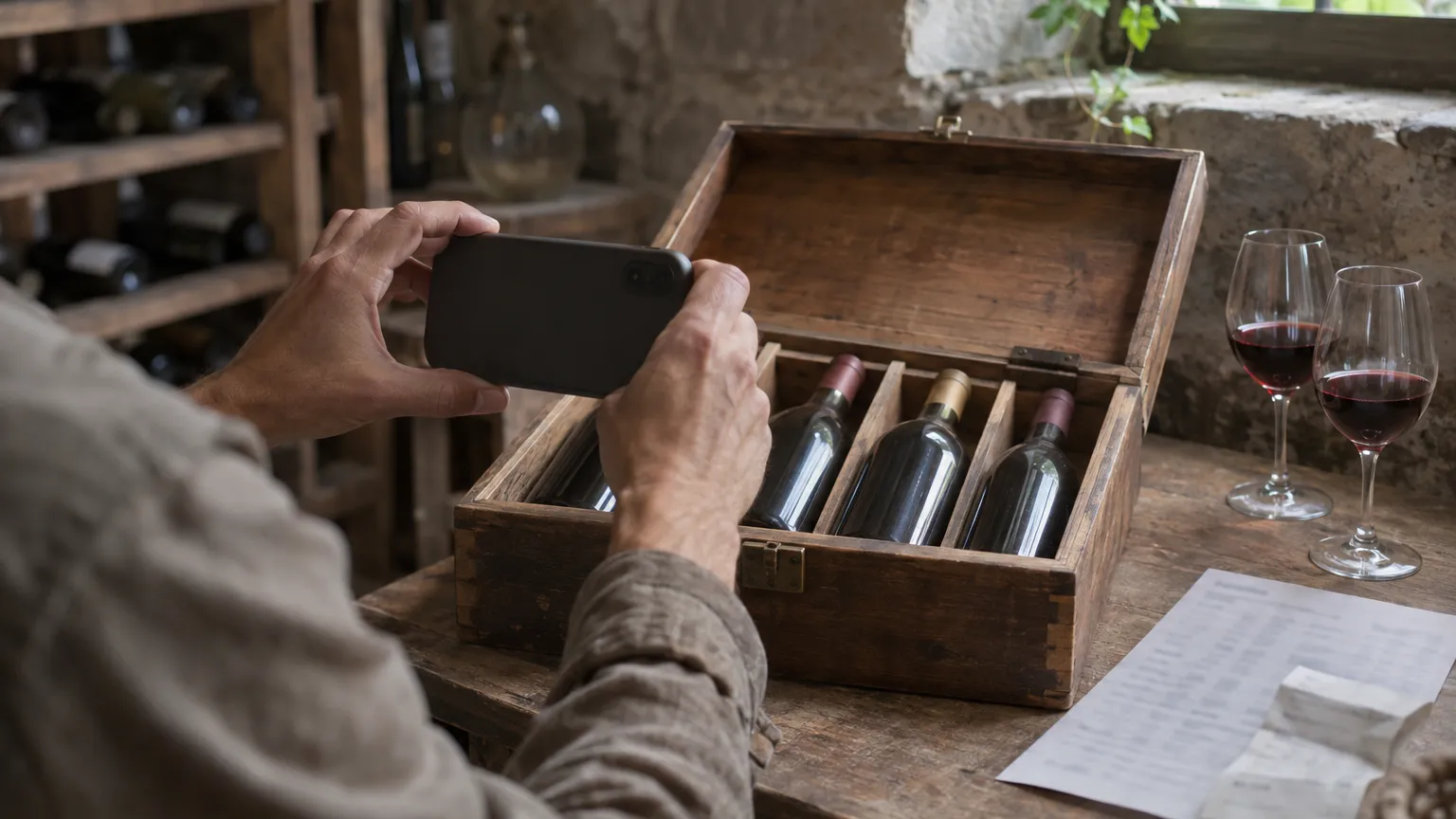
Count the bottles rack by rack. On the dated inventory, use one line for each lot of identical bottles stored in the same place. Record the producer, cuvée, vintage if shown on the label, bottle size and quantity. Add the location, the unit value calculated on the agreed basis and the corresponding supporting evidence. Multiply the unit value by the quantity, then add up the lines for each storage location.
For a recent purchase, you can add wines from the invoice. Before sending the inventory, check the imported quantities against your count: a bottle that has already been drunk or given away should no longer appear.
| Situation | Documents to gather | What still needs to be substantiated |
|---|---|---|
| Case purchased complete | Invoice detailing the wine, bottle size and quantity | The number of bottles still present on the inventory date |
| Older lot to be declared at replacement value | Original invoice if available, photo of the remaining bottles | The replacement value, supported by a dated offer for a comparable wine |
| Bottle received as a gift, without an invoice | Dated photo of it in its rack and, if possible, a statement from the giver specifying the wine given | The bottle’s value, supported by evidence accepted by the insurer, such as a comparable reference or a professional valuation |
Theft, water damage or cooling failure: what should I check?
Theft. For a storage unit in a basement, check the security requirements for the individual unit, not just those for the building’s shared entrance. Describe your unit’s door and lock to the insurer so they can confirm whether they meet the conditions for theft cover.
Water damage. Check that cover extends to the contents of the space. After a leak, a waterlogged carton does not mean that all the wine is lost. If you can do so safely, photograph the lots before moving them and record the damage observed for each affected inventory line.
Cooling failure. Cover for repairing a wine cabinet does not guarantee cover for its contents. Ask whether deterioration of the wine caused by a temperature change is covered. If it is, ask for the limit and any excess to be specified.
When should I review the sum insured?
After a major purchase, recalculate the total for each location using the agreed basis. Check the contents sum insured for all your belongings, then the specific limits for bottles, collections or the contents of outbuildings. If the value stored in the unit exceeds the outbuilding limit, increasing the contents sum insured alone will not necessarily make up the difference.
Make the same check before moving cases from your home to a storage unit: the total value does not change, but the applicable limit may be different. Updating the inventory does not change the policy. Send the new inventory and, if a change is needed, ask for written confirmation of it and its effective date.
By Arnaud Cariou, founder of Viniou
Article written on 22/11/2026