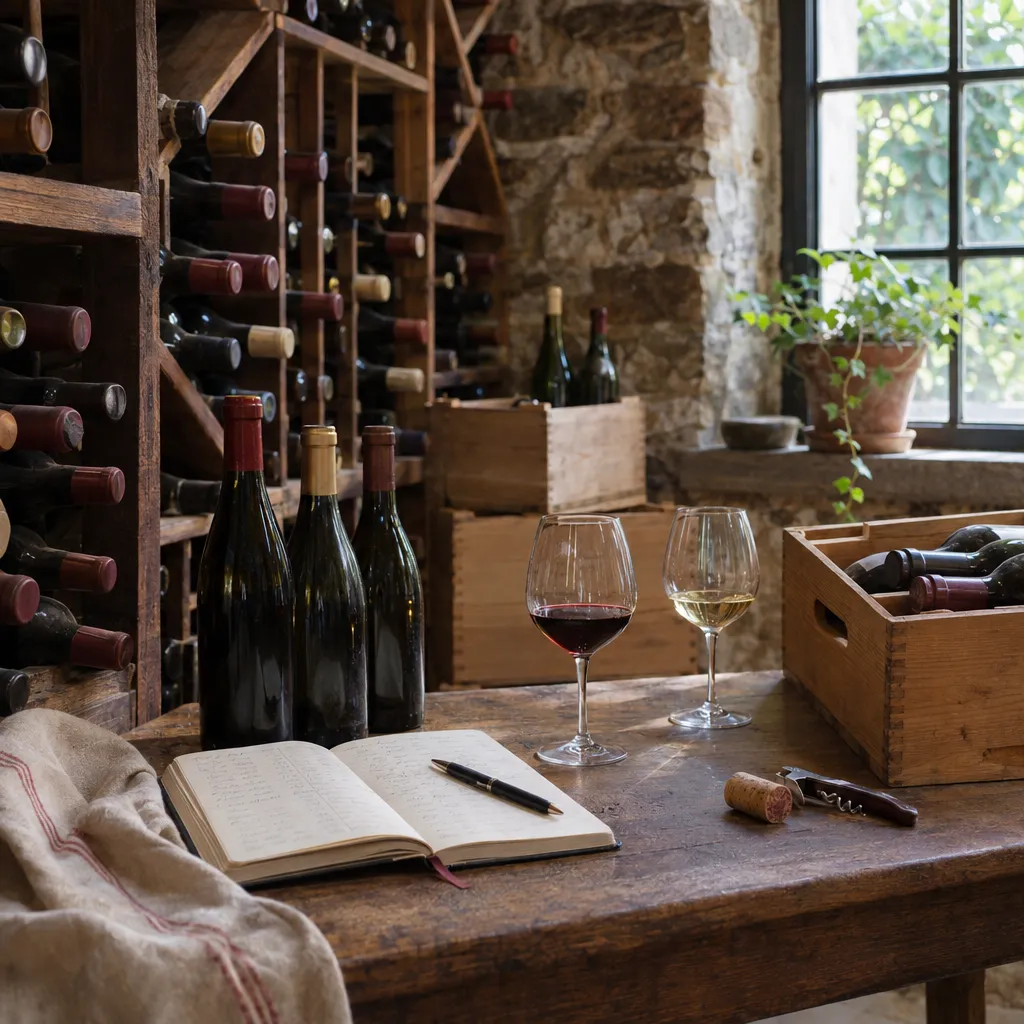
Managing a collector's cellar means balancing three flows: what you buy, what you drink and what is ageing while it waits. The basic rule is to separate everyday wines from those intended for ageing, know how quickly you consume them and open each wine during its drinking window rather than at random.
Key points
- Divide your cellar into everyday wines, medium-term ageing wines and long-term reserves.
- Calculate how long your stock will last: divide the number of bottles by your annual consumption.
- Buy wines for ageing in sixes or twelves, and open one every two or three years to follow its development.
- Record every bottle removed: it is the only way to spot forgotten bottles.
How should you divide your cellar between everyday wines and wines for ageing?
A collector's cellar containing only wines for ageing has a practical drawback: you hesitate to open anything on a Tuesday evening and end up buying from the local supermarket while the cellar ages without you.
| Category | Recommended proportion | Time in cellar | Examples |
|---|---|---|---|
| Everyday wines | 30 to 40% | Less than 3 years | Côtes-du-rhône, muscadet, beaujolais-villages, rosés |
| Medium-term ageing | 40 to 50% | 3 to 10 years | Crus of Beaujolais, saint-joseph, bourgognes villages, chinon |
| Long-term ageing | 10 to 25% | More than 10 years | Fine bordeaux, hermitage, barolo, sauternes, vins jaunes |
These proportions are guidelines, not rules. Someone who entertains often will want more everyday wines; a collector who buys en primeur will have more for long-term ageing. To choose wines in the latter category, see our selection of wines to buy for a long-term collection.
How do you calculate how long your cellar stock will last?
The calculation is simple: divide the number of bottles by the number you drink in a year. A household that opens two bottles a week consumes around 100 bottles a year. With 600 bottles in the cellar, it has enough to last six years.
This figure is useful for two reasons. If it greatly exceeds the ageing potential of your everyday wines, some may be past their best before you drink them. If it reaches fifteen or twenty years, your cellar is growing faster than you drink from it, and it is time to buy less or open more. Count only the bottles you drink, not those given away or resold.
WITH VINIOU Drink each wine at its peak Your wines sorted by stage so you can open them at the right time.How often should you buy wine?
Buy wines for ageing by the case
For a wine intended to age, a case of six or twelve bottles lets you follow its development over time. Open the first after a few years, then one every two or three years: you will know when it reaches its peak and still have some left to enjoy.
Replenish everyday wines as you go
Buy wines intended for drinking young in small quantities as you consume them. There is no need to stock three years' worth: most rosés are best drunk within two years, and the next vintage arrives at your wine merchant's every spring.
Group major purchases together
Bordeaux en primeur wines are reserved in the spring following the harvest, for delivery around two years later. The wine fairs held in late summer are another opportunity to replenish your medium-term ageing wines. Concentrating major purchases into one or two periods helps you keep track of your budget and available space.
How can you avoid forgetting bottles?
This is the real risk with a large cellar. A wine stored behind others, or in a case that has never been opened, can go unseen for five years.
Three habits reduce this risk. Store wines ready to drink at the front, and wines that need more time at the back or on higher shelves. Take a full inventory once a year, following the method in our article on taking a cellar inventory. And each season, review the wines entering their drinking window, with help from our guide to identifying wines ready to drink.
How can you track your consumption over time?
Managing stock relies on figures, and those figures come from the bottles you remove. Record the date, the bottle and, when the wine merits it, a few tasting notes. After a year, you will know what you actually drink, by colour and region, helping you make future purchases.
Viniou keeps track for you: additions, removals and tastings are linked to each wine's record, and every bottle's location is shown on the cellar plan. With Premium, the ageing stages of each wine provide a list of what is ready to drink now, with a reminder at the right time, and the cellar's estimated value is shown alongside the bottle count.
By Arnaud Cariou, founder of Viniou
Article written on 23/11/2026