A wine cabinet with a built-in humidifier keeps humidity between 60 and 80%, protecting corks from drying out during long-term ageing. It is particularly worthwhile in a dry home and for cork-sealed wines kept for more than five years. For bottles drunk within two years, a simple water tray is usually enough.
The essentials
- Ideal humidity is between 60 and 80%. It matters over time, though less than temperature.
- Most electric wine cabinets manage humidity passively, with no adjustable setting.
- Active regulation measures and adjusts humidity, using a reservoir that needs refilling.
- It is worthwhile for long-term ageing in a dry, heated home.
Why does humidity matter in a wine cellar?
Cork is an elastic material that reacts to the surrounding air. If the air is too dry, the outer end of the cork gradually shrinks, letting in a little more air and causing the wine to oxidise faster. The most visible sign is a falling wine level in the neck over the years.
Conversely, above 85 to 90%, labels become mouldy and peel off. This does not affect the wine, but a bottle without a legible label is difficult to identify and loses resale value. Our article on protecting labels explains the solutions in detail.
Keep things in perspective: a bottle stored on its side keeps the wine-facing end of the cork moist, and a few months in dry air will do no harm. Humidity becomes a concern when wines are kept for five, ten or twenty years.
WITH VINIOU A wine expert’s advice, effortlessly AI-powered tasting, storage and ageing advice.How does a wine cabinet with a built-in humidifier work?
In an electric wine cabinet, the cold surface that cools the air also causes some water vapour to condense. Depending on the appliance's design, the air inside can therefore become drier than the air in the room. Humidity regulation compensates for this.
Passive humidity management
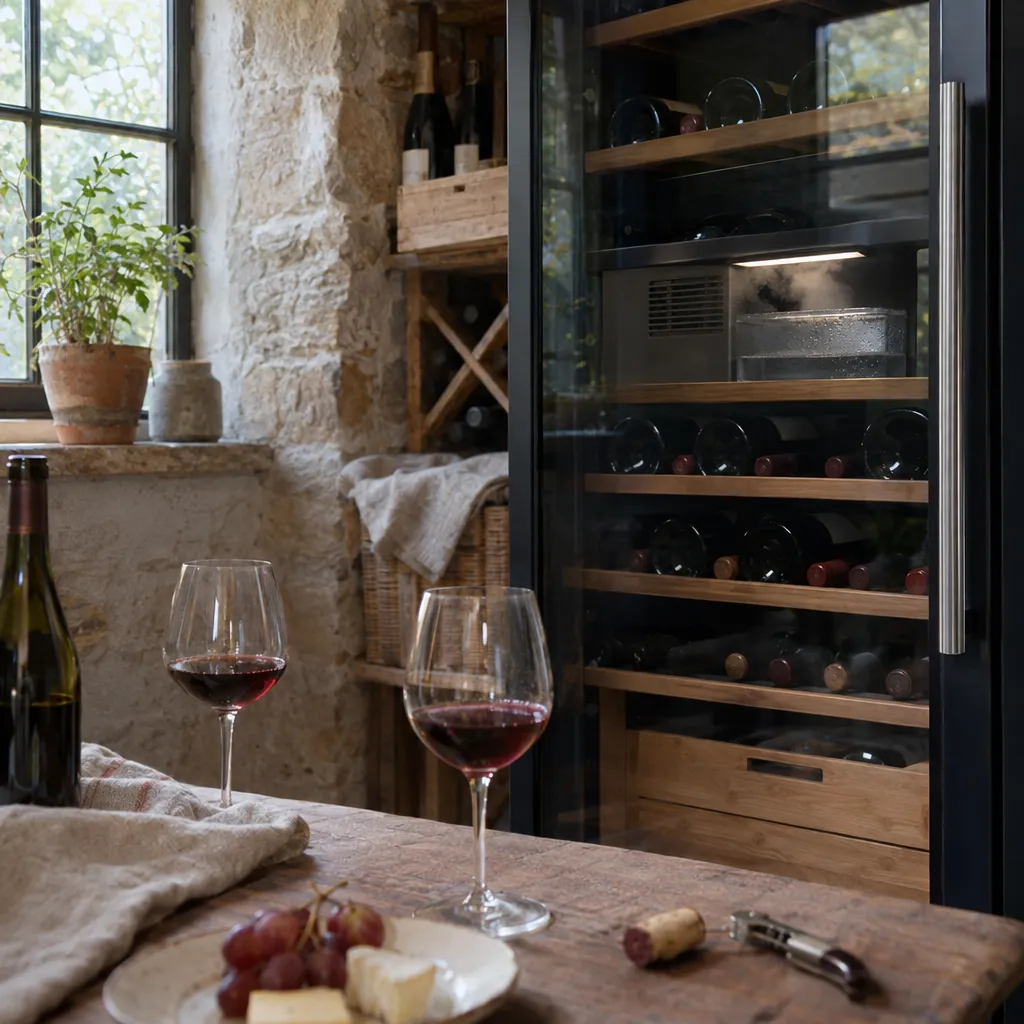
Most ageing cabinets have no humidity setting. They rely on a small water tray, a porous stone that retains water, or an airflow system designed to retain moisture. This works well in a normal home, without a display or controls.
Active humidity regulation
Models with a built-in humidifier have a sensor that measures humidity, a reservoir and a system that releases vapour when humidity falls below the set level. Humidity is shown on the control panel, just like temperature. Some models can also reduce excess humidity through ventilation, while others cannot: check this in the technical specifications.
When is a cabinet with a humidifier worth it?
Three situations justify one. First, a dry home: in winter, humidity in a heated flat often falls to 30 or 40%. Second, long-term ageing, with cork-sealed bottles you plan to open in ten years or more. Finally, a collection where label condition matters, for wines you might resell.
It offers little benefit for wines drunk within a year, for bottles with screw caps or synthetic corks, or if the cabinet is installed in an already damp basement. In the latter case, the risk is more likely to be excess humidity.
| Solution | How it works | Maintenance | Best for |
|---|---|---|---|
| Cabinet without humidity management | No provision for humidity | None | Wines drunk within two years |
| Passive humidity management | Water tray or porous stone | Fill the tray from time to time | Most ageing cabinets |
| Built-in humidifier | Sensor, reservoir, adjustable threshold | Fill the reservoir and clean according to the instructions | Long-term ageing in a dry home |
| Natural cellar (basement) | Ground moisture, ventilation | Damp gravel if the air is dry | Large collections |
What are the alternatives to a built-in humidifier?
Before investing, take measurements. A hygrometer costing a few euros, placed in your cellar over winter, will tell you whether there is a problem. If humidity stays above 55 to 60%, there is no need to do anything more.
In an electric wine cabinet that is too dry, a small container of water on the bottom shelf will often raise humidity by a few percentage points. Change the water regularly to prevent deposits and mould. In a room converted into a cellar, a bed of gravel or sand that is kept damp, or a portable humidifier, serves the same purpose. For temperature, light and other factors, see our wine storage guide.
How do you keep track of wines that need the most care?
Not all bottles have the same needs: a non-vintage champagne and a fine bordeaux intended for ageing require different care. Viniou provides storage advice for each wine in your cellar and records where each bottle is kept. You can then store wines intended for long-term ageing in the best-regulated area of your cellar, and those to drink soon where you can easily find them.
By Arnaud Cariou, founder of Viniou
Article written on 23/11/2026