

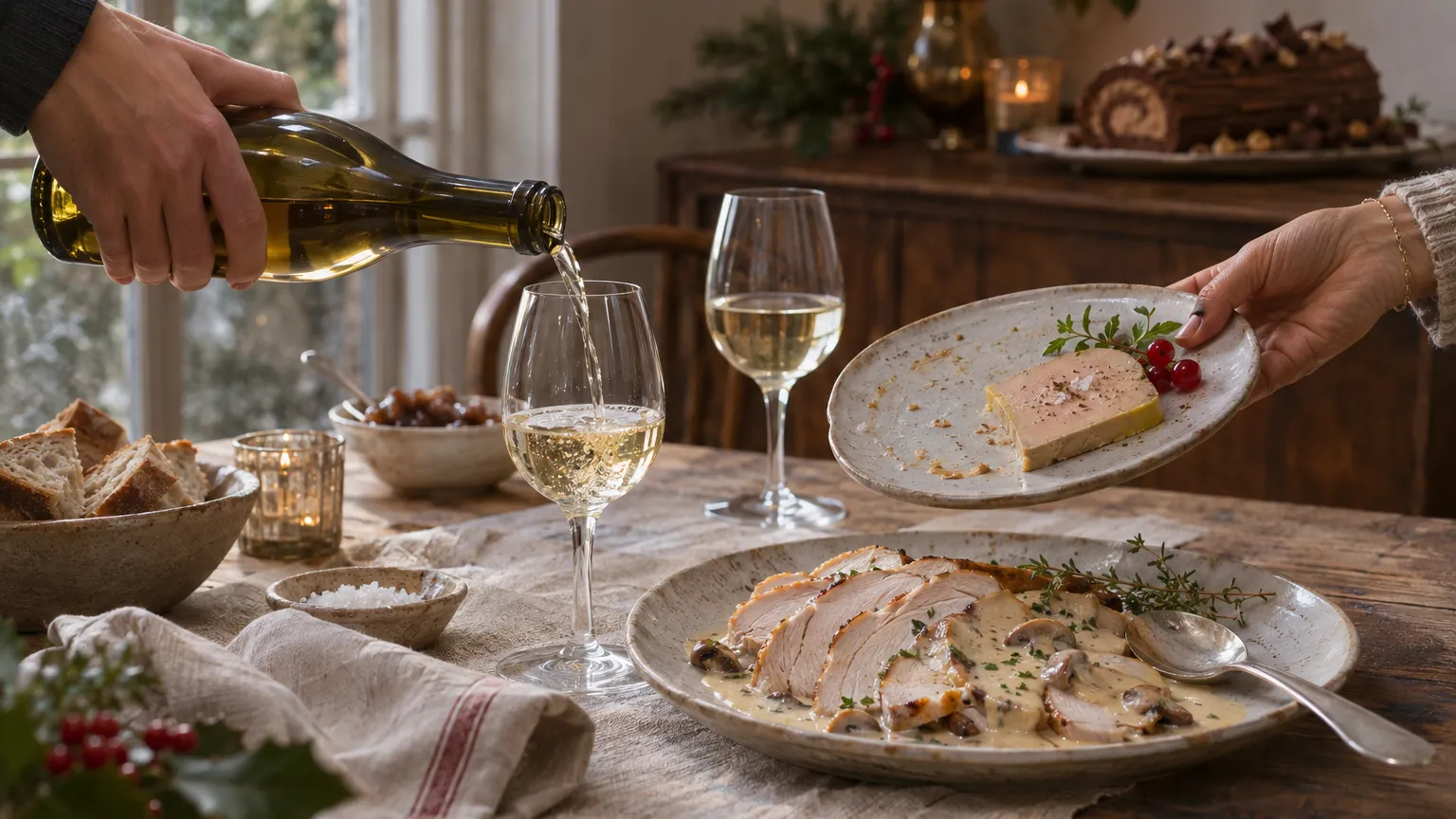
For a foie gras wine pairing, I would choose a dry Vouvray if the turkey that follows is served with a cream sauce: its freshness balances both the richness of the starter and the sauce. With a terrine accompanied by figs, I would prefer a small glass of Sauternes, then switch wines for the poultry. For dessert, the filling of the Yule log determines the choice: red Banyuls for dark chocolate, Clairette de Die méthode ancestrale for fruit.
The essentials
- Plain foie gras: if you choose a Vouvray, look for the word “sec” on the label. The appellation name alone is not enough.
- Terrine with figs: serve Sauternes at 10 to 12 °C, not ice-cold.
- Roast turkey with chestnuts: choose a Pinot Noir with supple tannins rather than a red that dries out the mouth.
- Fruit Yule log: if you want more sparkling wine, choose one sweeter than the brut served as an aperitif.
With foie gras, when should you choose a sweet wine over a dry white?
With a slice of plain terrine, both approaches have their merits. With a Sauternes, the appeal lies in the contrast between the wine’s sweetness and the saltiness of the terrine. Add a fig compote and the wine’s sweetness also complements the fruit. Serve Sauternes cool, at 10 to 12 °C. At a lower temperature, its aromas are less distinct.
With pan-seared foie gras served without a sweet condiment, I prefer a dry white: after a bite of golden, pan-seared foie gras, I appreciate the acidity of Chenin rather than a sweet sip. In Vouvray, this grape also produces off-dry and sweet still whites. Check the bottle for the word “sec”.
WITH VINIOU The perfect wine for every dish Personalised food & wine pairings for every meal.With turkey, keep the starter’s white or open a red?
Taste a bite of turkey with its sauce, not just a slice of breast meat. If the poultry is coated in cream sauce, keep the dry Vouvray: its acidity still comes through after the sauce. If you have just served a Sauternes, open a dry white instead. A fairly full-bodied white Meursault is a good choice for a thick cream sauce.
With roast turkey served in its juices or stuffed with chestnuts, you can switch to red. Choose a Pinot Noir with supple tannins, such as a red Bourgogne. Chestnuts give the stuffing substance, but turkey breast remains lean: a red whose tannins grip the gums will make the meat seem drier.
Does the aperitif bubbly work with the Yule log?
A brut that is pleasant to drink on its own can seem distinctly acidic after a spoonful of sweet cream. For a pear or peach Yule log, choose a Clairette de Die méthode ancestrale instead. It retains some of the grape’s sugar. It is this sweetness, more than the bubbles, that sets it apart from a brut at dessert.
With a dark chocolate ganache, serve a red Banyuls. The sweetness of this vin doux naturel softens the bitterness of the cocoa; choose a young one if you enjoy red fruit notes with chocolate. A few chocolate shavings on a pear mousse do not call for the same choice: in that case, stick with the Clairette.
Which bottles should you bring out of your cellar for Christmas Eve or New Year’s Eve?
In Viniou, the “Food and wine pairings” feature helps you find a wine among the bottles in your cellar to match a dish. Start with how the turkey is prepared: if you choose a dry Vouvray for the cream sauce, you can serve it with the foie gras too. Here are two serving sequences, depending on the menu.
| Course | Menu with turkey in cream sauce | Menu with turkey and chestnuts |
|---|---|---|
| Starter | Plain pan-seared foie gras: dry Vouvray. | Terrine with figs: a small glass of Sauternes. |
| Poultry | Turkey in cream sauce: keep the Vouvray. | Turkey stuffed with chestnuts: switch to a red Bourgogne with gentle tannins. |
| Dessert | Pear Yule log: Clairette de Die méthode ancestrale. | Dark chocolate Yule log: red Banyuls. |
Article written on 21/11/2026