


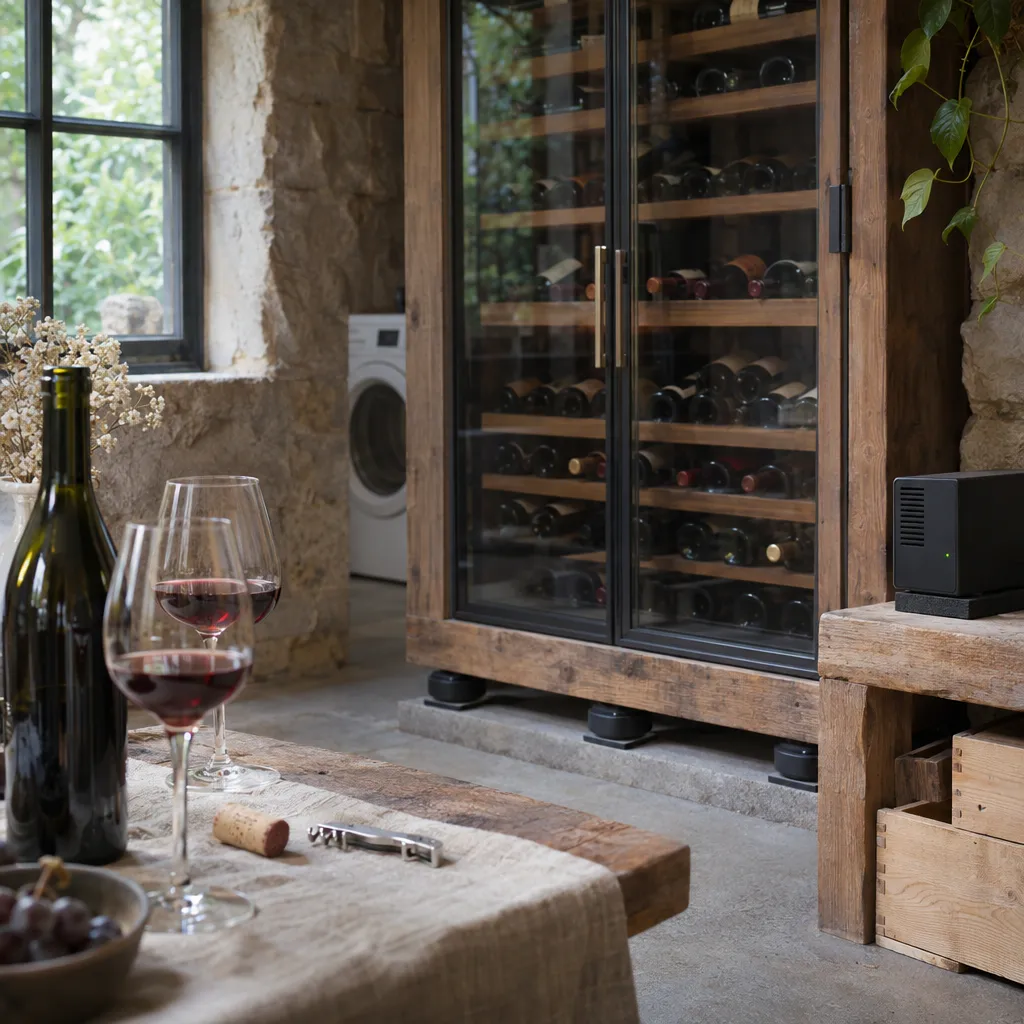
To protect a wine cellar from vibrations, keep it away from running appliances, place it level on a stable floor with anti-vibration pads, and handle bottles as little as possible. This matters most for wines kept for ageing and older vintages, whose sediment can be stirred up. For bottles drunk within a year, a few common-sense precautions are enough.
Key points
- Vibrations stir up sediment in aged wines; their effect on ageing has been little studied.
- The main sources are washing machines, tumble dryers, boilers, compressors and nearby traffic.
- A wine fridge should stand level on a hard floor, without touching the wall or another appliance.
- The most common source of disturbance is often a hand searching for a bottle.
What do vibrations really do to wine?
The best-established effect is mechanical. Over the years, a red wine kept for ageing forms a sediment of tannins and pigments that settles on the bottom or side of the bottle. Repeated jolts stir it back into suspension: the wine becomes cloudy and tastes bitter if served in this state.
Beyond that, caution is needed. A few studies suggest that strong, continuous vibrations alter certain compounds in wine, but they involve levels far higher than those found in an ordinary home. In practice, a wine kept for long-term ageing benefits from being left undisturbed, while a wine drunk young will not suffer from being stored in a wine fridge near a refrigerator.
Where do vibrations in a wine cellar come from?
In a home, the usual culprits are motorised appliances: a washing machine on its spin cycle, a tumble dryer, a boiler, a heat pump or a water booster pump. Then there are external sources: a road with heavy goods traffic, a railway line or an underground train passing beneath the building.
There are also the small jolts of everyday life: a slamming door, a wooden staircase above the racks, or a floating floor that transmits every footstep to a wine fridge standing on it.
WITH VINIOU A wine expert’s advice, effortlessly AI-powered tasting, storage and ageing advice.Is a wine fridge compressor a problem?
Compressor wine fridges work like refrigerators: the motor starts and stops as cooling is needed. Manufacturers mount it on rubber supports, known as anti-vibration mounts, which absorb most of the vibrations. A quality ageing cabinet often also has wooden shelves, which absorb vibrations better than metal ones.
Thermoelectric wine fridges have no compressor and barely vibrate, but their cooling power is limited: they are suitable for small collections in a room that stays at a moderate temperature. Absorption wine fridges, which are less common, are also silent. Above a hundred bottles, compressors remain the norm.
How can you reduce vibrations day to day?
Position the wine fridge properly
Adjust the feet so the fridge is perfectly level: a tilted appliance vibrates more and its door does not close as well. Leave the gap specified in the instructions between the fridge and the wall, which also allows the motor to ventilate. Never place it directly against a refrigerator or washing machine, and do not put anything on top of it.
Use anti-vibration pads
Rubber or cork anti-vibration pads placed under the feet absorb much of the vibration transmitted through the floor. On a floating floor, a rigid board under the appliance distributes the weight and limits movement.
Choose the right location
In a fitted cellar, place the racks against the wall furthest from machinery and the street. Secure large racks to the wall to stop them resonating. Materials matter too: our article on materials for fitting out a wine cellar compares wood, metal and stone.
| Source | What it produces | Solution |
|---|---|---|
| Washing machine, tumble dryer | Strong jolts during the spin cycle | Move to another room or place the machines on a vibration-damping base |
| Wine fridge compressor | Low vibrations each time it starts | Level the fridge, place pads under the feet and leave a gap from the wall |
| Boiler, heat pump | Continuous vibrations during heating | Place racks against the opposite wall, without contact with the appliance |
| Road, train, underground | Vibrations transmitted through the ground | Place racks against the wall furthest from the source |
| Handling | Bottles moved while searching for one | Know where each bottle is before opening the cellar |
How can you avoid moving bottles unnecessarily?
In a full cellar, looking for one bottle often means taking out ten. This repeated handling is what disturbs wines kept for ageing most. The answer is to know where each bottle is before opening the door.
With Viniou, you can recreate your racks in a 3D cellar plan, with a location for every bottle. You can go straight to the right slot and leave older vintages undisturbed at the back. For other storage conditions, including temperature, light and humidity, see our wine storage guide.
By Arnaud Cariou, founder of Viniou
Article written on 23/11/2026