

Organising your cellar means choosing one system and sticking to it, then making every location easy to identify without taking out the bottles. The most effective method combines organisation by drinking window, a label on each rack and a tag on each bottle neck. The rest depends on the size of your cellar and your habits.
Key points
- Four ways to organise your cellar: by colour, region, drinking window or occasion.
- Below 100 bottles, colour is enough; above that, combine two criteria.
- Label the racks, not just the bottles: the neck is the only part visible when bottles are stored horizontally.
- A QR code on each rack or bottle links its location to the wine's full details.
Which system should you choose for your cellar?
There is no single right way to organise a cellar, only a system that suits the way you drink. Before moving a single bottle, ask yourself what you look for when you go down to the cellar: a wine to pair with a dish, a wine ready to drink or a particular bottle.
By colour
Reds on one side, whites on the other, with rosés and sparkling wines separate. This is the simplest system, and it has a practical advantage: whites and sparkling wines, which are more sensitive to heat and light, can occupy the cooler lower rows. It becomes insufficient beyond 100 to 150 bottles.
By region
Bordeaux, Bourgogne, Rhône, Loire, Alsace, Languedoc: each region has its own area. This is the most natural system for those who know their wine, as it follows the way they buy and think about food pairings. We explore it in detail in our article on organising wines by region.
By drinking window
Put wines to drink within the year at the front, and those that need more time at the back or higher up. This system prevents the costliest mistake in a cellar: forgetting a bottle until it is past its best. It does, however, require you to know how long each wine will keep and to move bottles as the years go by.
By occasion
Everyday wines, wines for entertaining and special bottles reserved for birthdays. Practical in a small family cellar, this system remains subjective.
WITH VINIOU Find a bottle in a flash A QR code to stick on, one scan, and it’s identified.How do these systems compare?
| System | Cellar size | Strength | Limitation |
|---|---|---|---|
| Colour | Fewer than 150 bottles | Immediate, no upkeep | Too broad for a large cellar |
| Region | 100 bottles and above | Intuitive for food pairings | Uneven sections if one region dominates |
| Drinking window | All sizes | No wines forgotten | Bottles need moving each year |
| Occasion | Small cellar | Simple for the whole family | Subjective system |
In a cellar with more than 200 bottles, the most reliable combination is to organise first by region, then by drinking window within each section: wines ready to drink at the front, wines for ageing at the back. For a fast-growing collection, stock rotation becomes the key issue, which we cover in our article on managing cellar inventory.
How should you label your bottles and racks?
Rack labels
A label for each row or slot, attached to the rack frame, identifies the section and sometimes the wine. Choose a material that can withstand cellar humidity, typically around 70%: plastic, slate or a laminated label. Number the rows and columns, for example A to F and 1 to 12, so that each bottle has a precise location.
Neck tags and labels
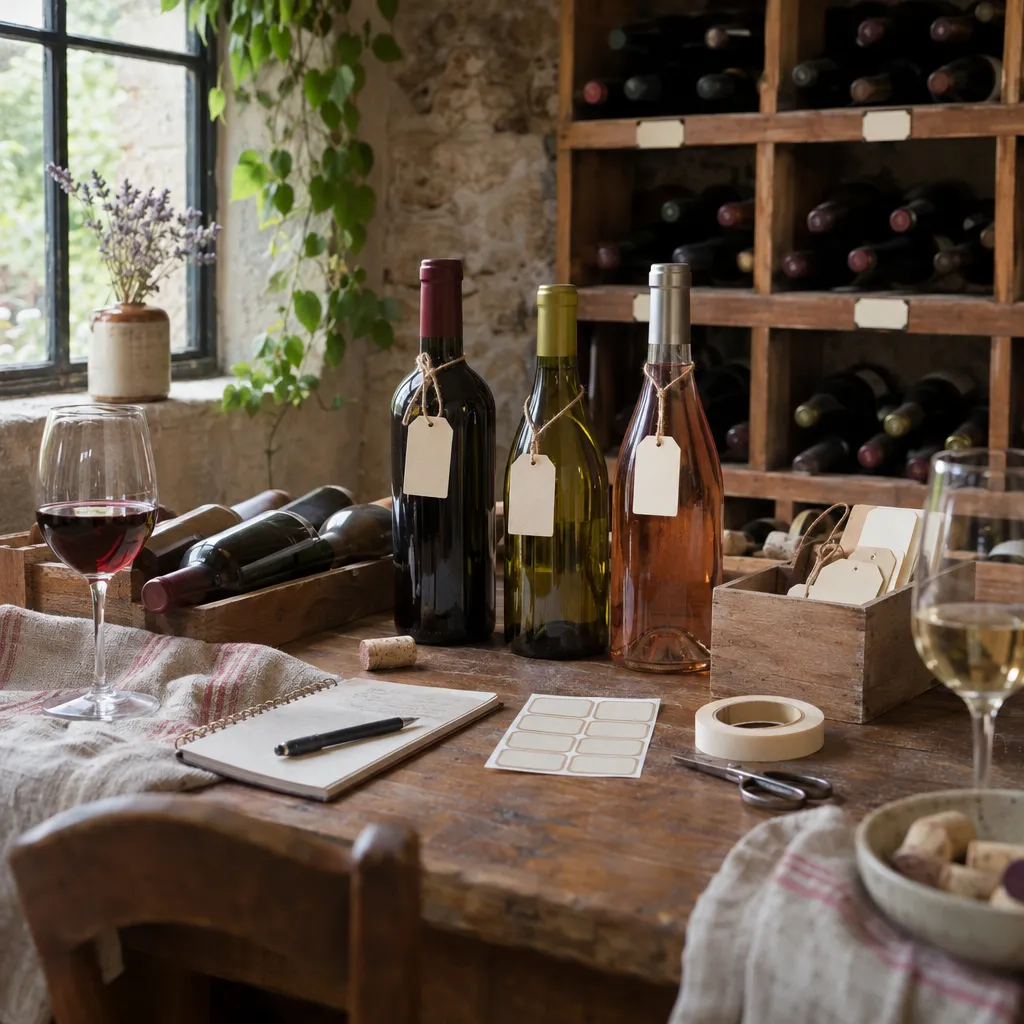
When bottles are stored horizontally, only the neck is visible. A tag hanging from the neck, bearing the wine's name, vintage and drinking window, saves you from pulling out the bottle to read its original label. To preserve those labels, read our advice on protecting bottle labels.
QR codes
A handwritten label can never tell you everything. A QR code attached to the rack or hung from the neck takes you to the wine's full details when scanned with your phone. Viniou lets you print QR code labels for racks and bottles: a quick scan with your phone is all it takes to find the wine in your cellar.
How can you find a bottle without searching through your cellar?
Physical organisation has a limitation: it only answers one question at a time. A cellar organised by region does not tell you which wines are ready to drink, and one organised by drinking window does not tell you where your Bourgogne wines are.
This is where an up-to-date inventory complements your labels. In Viniou, every bottle is placed on the 3D plan of your cellar, rack by rack. Find a wine in your inventory and the app shows you its rack and slot. With Premium, a list of wines ready to drink now supplements your own system, whatever it may be.
Article written on 06/04/2025 · Updated on 22/11/2026